Imagining Space Otherwise
Critical perspectives from the arts on space exploration
Imagining Space Otherwise is an international working group focused on the arts' role in shaping outer space's ethics, politics, and cultural imaginaries. Our goal is to produce an arts-centred and science-informed space humanities scholarship that directly contributes to the formation of extraterrestrial epistemologies—modes of knowing that confront the planetary and interplanetary consequences of space exploration. Through public programming, artistic partnerships, and cross-disciplinary scholarship, this work benefits global audiences, especially those currently marginalized in space discourse, by advancing inclusive, critical, and culturally grounded approaches to shaping our planetary and interplanetary futures.
The working group comprises scholars with extensive experience in performance studies, anthropology, media theory, and critical science and technology studies. Led by UCLA-based Principal Investigator Felipe Cervera (UCLA, USA), the group includes: Fiona Annis (University of Montreal, Canada), Vivian Appler (University of Georgia, USA), Eleanor S Armstrong (University of Leicester, UK) Maaike Bleeker (Utrecht University, The Netherlands), Marie-Pier Boucher (University of Toronto, Canada), Jennifer Crouch (Independent Researcher, UK), David (Jeeva) Jeevendrampillai (The University of Manchester, UK), Anne Johnson (Universidad Iberoamericana, Mexico), Evan Moritz (University of Toronto, Canada), Lisa Rand (Independent Researcher, USA) Juan Francisco Salazar (Western Sydney University, Australia).
This project is funded by the UCLA Global Advisors Council, UCLA Centre for Performance Studies, Department of Film and Theatre at the University of Georgia, and the Department of Social Anthropology at the Universidad Iberoamericana.
Centering on the “otherwise” as a conceptual pivot, the speakers in the sessions will offer various perspectives on how the arts constitute methods and objects for knowledge generation in space-related debates.
SEASON 2 NOW ON!
SEASON 2
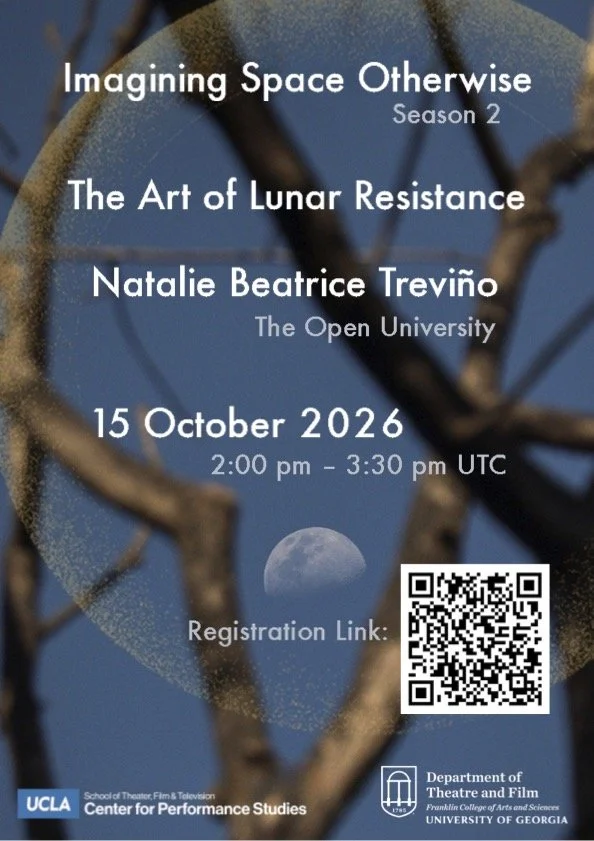
2.3 The Art of Lunar Resistance
Natalie Treviño
15 October 2026, 2 pm UTC
REGISTER HERE
As Lunar activities increase, dominant players in space exploration (NASA, EU, SpaceX, etc.) continue to use colonial language and metaphor to drive economic interest in the Moon. Exploitation of Lunar resources seems to be at the centre of this current Lunar craze. While anti-colonial critiques of space exploration are well established, they do not stop these colonial capitalist activities. How might daily practices of resistance and admiration (of the Moon and space) help restructure the ongoing Earth-Moon activities and discourses? Through collecting folklore, art, personal stories, and examples of non-human relations to the Moon, Natalie proposes that everyday resistance is possible.
-
2.1 Mechanical Fracture
Nicole Bettencourt Coelho with Jennifer Crouch.
This experience invites you into the practice of mechanical fracture. Mechanical fracture is the process that shapes glass into parabolic mirrors used in handmade telescopes. The bodily work, time, and knowledge slowly acquired in situ --- techniques fine-tuned over months, years, and lifetimes --- are transmitted to carry out this labor of love and are cited as a source/portal/threshold where connection to worlds and forces beyond Earth can emerge. You are all invited into the sound, gesture, and movement of mechanical fracture as we share the technical, critical, and sensual aspects of this process.
-
2.2 Black Fire!
Thandi Loewenson with Eleanor S Armstrong
POSTPONED
In this series of encounters and drawings, we enter the cosmos and find the Earth. Extraterrestrials wearing farmworker overalls land on an orchid house in Zimbabwe and only the Black labourers have an explanation for such strangeness. Fragments of detritus orbit the planet and produce a new geological layer, ripe for archaeological excavation. In these accounts and technofossils, the settler colonial logics of extraction, racialisation and depletion of the planet are found, operating in and through space. Liberation ideologies are forged here too. Trickster spirits, social movements and slippery materials frustrate white-supremacist capital at every turn. Here the story of space is a materially African endeavour: Lumumba is in the stars, Uhuru in the sky and, unfortunately, Rhodes too still runs amok.
-
2.3 The Art of Lunar Resistance
Natalie Treviño
As Lunar activities increase, dominate players in space exploration (NASA, EU, SpaceX etc.) continue to use colonial language and metaphor to drive economic interest in the Moon. Exploitation of Lunar resources seems to be at the centre of this current Lunar craze. While anti-colonial critiques of space exploration are well established, they do not stop these colonial capitalist activities. How might daily practices of resistance and admiration (of the Moon and space) help restructure the on-going Earth-Moon activities and discourses? Through collecting folklore, art, personal stories, and examples of non-human relations to the moon, Natalie proposes that everyday resistance is possible.
-
-
-
1.1 Cosmographies
Featuring Juan Francisco Salazar Sutil and Victoria Hunt
Juan and Victoria discuss their film Cosmographies, laying out the deep connections between social justice and space exploration that they explore through their artistic practice. You can find more information about the film here and watch it here.
-
1.2 Institutions
Featuring Venzha Christ, Aoife van Linden Tol, Nahum, and Miha Turšič
What are the institutions the artists imagine in the context of space capitalism? Beyond infiltration, how can we imagine our role in space institutions otherwise? text goes here
-
1.3 Autonomous Intergalactic Space Program
Featuring Rigo 23 and collaborators
The artists discuss the process of creating an "Autonomous Intergalactic Space Program" inspired by the Zapatista concept of "Another World, Another Path." ption text goes here
-
1.4 Art/Anthro: Methods, Forms, and Frictions
Featuring Joseph Popper, Lauran Reid, and Sarah Fortais
WATCH HERE
What kinds of worlds become thinkable when art and anthropology work together, and what methods must be invented, retooled, or reclaimed in the process? description -
1.5 Dis-Orienting Bodies - Performing Space
Featuring Kira O’Reilly + Marie-Pier Boucher
A performance reading of two voices exploring performance as a mode of planetary attachment and as a method of bodily and spatial dis-orientations. Offering a series of propositions informed by their correspondences across time and space, their dialogue explores a poetics of physicality, mutability, and alterity.